this is going to be the main chunk of my site. an informal place to create something from my notes and thoughts on the world. landscaping my mind palace perhaps. enjoy :)
not to be confused with a note about "living questions"! this is merely a list of questions i have/topics i want to explore
whats up with all the cute tinned fish?
how can i make my own religion out of attention?
what is the mayan concept of "in lak'ech"?
history of photobooths?
where do words fail me?
nike was onto something, shadow keeping, etc.
7/13/2026
it’s crazy when you realize that the only way to do something is to…do it. like literally you just have to do it sometimes. i don’t think i ever really forget this but there’s long chunks of time where it’s very quiet. i spend my time trying different things around whatever it is i want to do…trying to cultivate the right routine or environment to start a new habit, hoping that if everything else is just right that i’ll magically start doing things differently. but this doesn’t work! obviously there's certain things that do indeed require something other than willpower to get done but that's not what i'm talking about. for me this is moreso stuff like journaling, doing my meditation practice, starting my days without my phone. sure there are some tricks you can try to remind yourself to do them or make it easier, but at the end of the day it comes down to just deciding to do it.
i've been pretty good but spending too much free time watching tv (i kissed a girl season 2 :p), youtube, and other bullshit. it makes my mind loud and makes it harder to do anything else that i actually like to do. so today i woke up and i told myself i wouldn't go on youtube, watch tv, go on laptop instagram or hinge. and i forgot how good it feels to actually live in my life. i've only been listening to ambient music as well so it's just been really quiet and i can hear myself think. but not in a scary way. in a way that feels manageable. my little head will notice something or have an idea and i actually can engage with it. maybe look something up, do whatever thing i just said "oh i should do that" without instantly forgetting it or drowning it out with new noise.
i'm being a bit dramatic because it's only been a day but i have had long phases of my life lived like this and its soooo nice. feels good to remember that it's possible. i've been thinking about making an instagram again for a more creative project. when i was in highschool my personal account turned into fanaccountforthesun because i posted primarily pretty pictures of light and shadows and whatnot and people would send me pictures from all over the world. that was pretty cool and i sometimes wish i had never deleted it. i'm still really drawn to the sun and its light and particularly shadows and i take a lot of pictures/videos of them and i've been thinking about starting an account for just that. i keep trying to ask myself what purpose that's serving, what itch it's scratching, etc...feels like i have to do that when it comes to something i've deemed bad (social media) but maybe it doesn't have to be that deep? idk i'm gonna think about it. i think it could be cool to even do some voiceover stuff or even animations now that i have an ipad. i love to find shapes in shadows. i've been trying to articulate some thoughts on why i like them so much. maybe that'll be next. i hope to write something more interesting some time soon. maybe more of a research bite or something more profound than "ive been off social media for 6 hours and it feels great"
anyways, thanks for being here.
oh! thats who i am!
7/01/2026
been too long! i hope someone is reading this still. hello i love you if you are.
i met someone yesterday that reminded me of all of the things that make me feel like myself. it feels really good but scary. i think i like this person too much. they are about to move and have already said it couldnt be more than platonic and im fine with that. i honestly do not mind internally going crazy over a person...as long as it doesnt make me treat them weirdly. i like getting to know people that i think are really cool and sometimes that platonic/romantic line gets kind of blurry so boundaries are helpful. the rest is just in my head and i can deal with that.
i met them the first time last week while i was out but yesterday we hung out just the two of us. it was a great hang. i walked home feeling like i was looking through my actual eyes for the first time in a while. probably since before i moved. i got to talk about things i had been reading and how i see the world and how that feels and it was all just like a confession and a reminder of who i am.
quick tidbit today. ill be back soon.
all my homies love me & the moon
6/02/2026
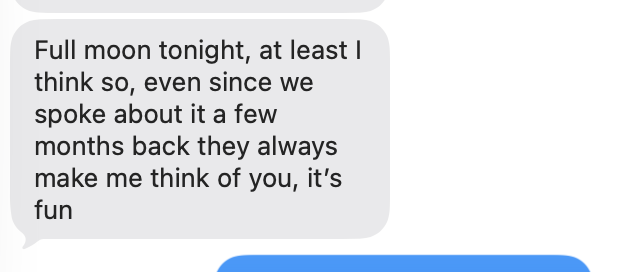
last thursday i got this text from my roommate... who i guess is no longer my roommate, just my friend:
it's supposed to say "ever since we spoke about it" in which she refers to me explaining a gap in communication between me & my ex lover in january.
back in september,october, november, my ex lover and i (current lover at the time) kept remarking how every time we saw each other it was some how a full moon. it made no sense. we saw each other very often and the full moon is only once a month. but somehow--likely due to the speed of the last semesters of university--it felt like it was always a full moon. we were shocked. wasn't the full moon last week? how could this be again? as lovers of the moon, we weren't put down by the fact that this was just the speedy passing of time, but we took it as more time to honor the moon.
and then we separated for winter break. in the middle of december, having only been apart for a week or two, i couldnt help but notice that ever since being apart, the moon was sooo small. again, nothing was really changing with the speed of the phases of the moon, but it felt like it was a crescent every time i looked up in the sky for weeks on end. i thought there was something really romantic in this observation. it felt like the moon could only be full when we were together (even though other stages are just as lovely). i tried to communicate this to my lover, but i could tell it didnt resonate with them the same way. that tended to be the case with a lot of things, and something i struggled with in our relationship.
when i returned to university in january, we broke up on unrelated reasons. but in my reflecting on the relationship, i brought up this specific moment with my roommate. ever since, for five full moons now, she has spoke to me or texted me about the full moon and thinking of me. it nearly makes me cry every time.
i think there's something to be said about being able to enjoy romance with yourself, to see something lovely and share it with no one but your own thoughts. but it does feel quite special to be able to find that same romance and thoughtfulness in a platonic love. even if i couldn't make my lover notice the same things as me, it feels pretty great to know that my roommate, who is more like a sister to me, thinks of me when she sees the moon.
tuning my looking eyes
5/06/2026
my last few notes have been loosely related to iris murdoch's moral philosophy on goodness. i recently finished it and then was really busy and burnt out with the end of the semester so i have not really been reflecting on it. ive been very much mind numbingly not paying attention to the world. im ready now though.
let me start by trying to sum up some takeaways from the book as a whole. i think this one quote from the end is a good starting point: "we act rightly 'when the time comes' not out of strength of will but out of the quality of our usual attachments and with the kind of energy and discernment which we have available." here murdoch is explaining the significance of our attention, where what we pay attention to and how we pay attention to it, shapes how we are able to show up in the world. this is why she says we must pay attention to beautiful things and goodness as a source of energy and as a value shaping exercise.
throughout the book, murdoch turns to great art often, and at the end, academia and other skills, as potent places to discover true value. she writes that the great artist, who does not fantasize and infuse the art with their self, has the ability to show us real life. "it is not photogrpahic realism, it is essentially both pity and justice." the removal of the self is the most important part, which is why she suggests that out of all the variations of the virtuous man, the humble man may be most likely to be good. this removal of self is why she points to academia and intellectual disciplines, such as learning a langauge. when we devote ourselves to learning a new skill, it is a continuous revelation of something that exists outside of yourself.
anyways, there's a lot more in there. the middle chapter goes through an extended metaphor to posit goodness as an alternative to god. i think the biggest takeaway is that our minds are constantly compromised by anxiety, fantasizations (daydreams), etc...always looking in relation to the self. paying attention to beauty and the mystic, whether it is nature, art, the pursuit of knowledge, etc. allows us the opportunity to clear our consciousness and gives us energy. they expose us to the real world, the absurd random minute details, the natural goodness that exists, and allow us to show up in the world more virtuously. in the face of such absurd beauty, there is a certain meaninglessness of life revealed. murdoch doesn't lead us to nihilism from here, but towards an ethics of being good for nothing. she says, if there is any consolation it is "the austere consolation of a beauty which teaches us that nothing in life is of any value except the attempt to be virtuous."
i think this is a really beautiful (lol) way to approach life but it really is hard work these days to commit to "the task to come see the world as is." in the midst of so many distractions, im turning to small enclosed moments to linger in beauty. perhaps in another note ill talk about the significance of enclosed moments and habitable time, but for now this looks like: reading a poem going to local exhibits walking my dog with no music or distractions taking spring inventories touching things that look nice and now an exercise of 40 observations
i wanted to insert the photo (screenshot of a tweet that i saw on pinterest...) but i cant find it. the idea was for 4 weeks to write 10 observations a week. anna howard does something similar that she calls "poetry watching" like people watching, but its essentially just an exercise of noticing. i think the post said something about this revealing the "answers" whatever that means...i dont think it will lead to any life changing revelations, but i am going to do it anyways. i feel like im pretty good about paying attention to things but i dont normally write these things down, unless im like reflecting on it but the point is for it to be absolved of myself. i will list them here.
week 1. 5/6-5/12
1. bubbles the dog got a new harness for the spring time
2. every ripple from raindrops in puddles is made of perfect circles
3. the clouds make the night sky look like a felted moving blanket
4. a cardinal fluffs itself up on the telephone pole 5. brown cedar shake house sets up for new garden beds 6. a leaf got camoflauged on the train tracks under the yellow paint 7. the couple with 2 strollers, 2 babies, and 2 cats lives above the pizza place 8. another squirrel dead in the courtyard 9. no one is dancing in the lesbian bar 10. two shattered heineken bottles glitter their green week 2. 5/13-5/19
11. on my bedroom ceiling there is a square of light and two shadows from my bronze frogs on my windowsill 12. a very happy baby smiles in the stroller, mom has no idea 13. a little finch fits perfectly under the fence 14. there's no birdds at the usually busy (and empty) birdfeeder, but today its full 15. the power line at the corner looks like a green giant because it is covered in vines 16. pre-school has a bucket of bits of string for the birds to take 17. shadows merge recklessly. the sun doesn't discriminate 18. two pieces of graduation confetti fly out of my bag 19. 20. week 3. 5/20-5/26
21. 22. 23. 24. 25. 26. 27. 28. 29. 30. week 4. 5/27-6/2
31. 32. 33. 34. 35. 36. 37. 38. 39. 40.
so uh i gave up on this! i found myself getting soooo in my head about the wording of things and picking which things mattered or "counted". i was narrating every little thing i saw. which i guess in a way was a good practice, that practice of looking, but that didnt translate well when it came to actually making a list. anyways, some more thoughts to come on beauty and looking. i accidentally crafted a beautiful reading succession with society of the spectacle, sovereignty of good, and now ways of seeing. i am excited!
is laziness immoral?
4/17/2026
ok apologies my last entry made no sense...i know what i was getting at but i did it poorly (but i did it and thats what we're here for!). anyways, just watched a video about habits and something clicked in connection with the murdoch i've been reading. i wont explain murdoch's entire moral philosophy (not that i could if i tried) but to her, the ideal moral achievement is to have no decisions. bear with me
this is situated in the broader philisophical discussion of morality and decisions and will and what makes a person (if its public action or internal morals and values/etc). murdoch believes that the internal stuff cannot be separated from our actions. she says that what we pay attention to, and how we pay attention to it (ideally with a continuous process of learning and looking through love), shapes structures of value around us. so much to the point that by the time we are faced with a decision, most of the deciding has already been done. and the extreme of that is that one becomes so set in their moral structure that there are no decisions. one is just obedient to their will. maybe its becoming clear where habit is gonna tie into this...
in the habit video, the creator (olivia unplugged) started by talking about decision fatigue and my gears started turning...she goes onto say that you can't "outsource your life to whatever you want to do in the moment" and points to habit as an anchoring, as pre-decisions (i mean duh but this really struck me). shes talking about decision fatigue in the context of overstimulation and burnout and lack of direction, but perhaps this is a moral issue too?
this is starting to remind me of a point made in audre lorde's "uses of the erotic." the piece is talking about the power of pleasure and the political direction we get from feeling our lives fully and following the things that feel good. at one point she starts to get into discipline, because unfortunately, it is hard to do the things that you know will be fulfilling! because they take time ! and effort! and its so much easier to just feel OK by doing what youre doing right now rather than working for something better!!! but thats lame!
anyways...lorde says "giving in to the fear of feeling and working to capacity is a luxury only the unintentional can afford, and the unintentional are those who do not wish to guide their own destinies"
phew. im gonna let that one stand on its own.
ok circling back...murdoch says that how we show up in the world is based on our value structures that we build constantly by what we pay attention. morality becomes a continuous process that happens between choices. it is knowledge continually formed by "a patient and just discernment and exploration of what confronts one." the ultimate moral achievement is to have no decisions, just obedience towards will, "a patient loving regard" for one's will, the morals one has built. i dont remember where i heard this but someone talked about "rituals as a container for a life," and yes, here we are. i think habits are a container for building morals. they become structured time to do the same thing and carve the self around it, through it. through habits, choices become less about willpower, but obedience built upon loving intention and attention. our habits alter the "fibers of our being"...we become what we do and we do what we are. so go do something thats important to you! and do it again tomorrow. and the day after that!
how do i make my private life mean anything?
4/15/2026
in the last few weeks, ive been feeling pretty frustrated with myself about not doing the things i want to do or say im going to do. whether its as small as picking up the piece of trash i just saw on my floor or committing to a bed time routine, i keep going letting myself down. i know that on the baseline level, i am doing just fine. i am doing all of the things i need to get done...to stay alive, to graduate, etc. im doing a good job. but i cant help but feel frustrated and im not sure its a bad thing to want better for myself than just staying afloat (granted, its even better than that but yk what i mean).
i have "devote myself" on my 2026 bingo card and the concept of devotion and ritual and attention as religion are things that will definitely come up here again. i was talking to a crush (!) about rituals and pulled up another maggie nelson quote about the pleasure of dependency and what she calls ordinary devotion. she talks about ordinary devotion with respect to mothers/parents/caretakers and how it is through this ordinary devotion that we are all alive today and have been for generations. but i was then thinking about the ordinary devotion we all pay to ourselves to simply stay alive. maybe its just a survival instinct sometimes, but more often than not, its love, curiousity, hope.
i keep turning back to this idea of self devotion and self respect as a way of doing the sometimes tough love work of putting in the effort for things you really want even when it feels hard. i think of this with having more discipline about my screen time, going to the gym, working on my exciting projects, etc...these things arent like toxic hustle culture, they are things that i want but actively hold myself back from.
part of why i made this site again was to have a space to put things that i think about rather than just my head. i had always kinda struggled with feeling creative...i felt i had creative ideas and thought maybe that was enough but something was telling me it wasnt quite. and now im reading iris murdoch's "sovereignty of good" and i think im getting somewhere. i havent fully gotten into her theory yet, but shes been explaining this tension in philosophy about the reality and significance of the private. specifically talking about introspection and decisions, shes explaining how the internal only becomes meaningful or legible through public contexts (ie. me saying ive decided i am now going to do x, doesnt hold any weight if i dont do x, or unless you see me not do x). even on an internal level, we are only able to explain ourselves using public contexts in language. anyways i forgot where i was going with that...essentially talking about how doing introspection isnt really actionable so i should try to create space to make things that exist in the tangible world.
whenever i start reading stuff like that i kind of enter panic mode and think about what my life means and what my self concept means in relation to how people perceive me blah blah blah. but what i just got to in the book, is her starting to say well those theories dont really account for the ways that the introspection and internal stuff changes the fabric of your life. i think about how when you read a book, even if you dont remember everything that happened, it alters your brain on some level. the internal things shape you and how you then show up in the outer world.
ive strayed a bit and im not sure exactly how to tie everything back together...not sure how thats going to help me get the f*** off my phone and do my homework but i think theres something there...hmmm much to think about
when did jumping become embarassing??
4/8/2026
ok i dont know if im onto something but this popped into my head last night while i was getting my dog's dinner ready and he was jumping up and down out of excitement (jumping for joy). i started thinking about little kids and how often they jump...skipping rope, hopscotch, trampolines, jumping when excited like my dog. again, maybe this is just me, but i don't think the adults are jumping! what's up with that?
i guess there's adults who jump rope or play sports that involve jumping, or adults who jump at the occasional concert. but i think jumping has become embarassing. and its not just about taking up space or emoting, there's something specific about jumping that feels particularly childish. why???
i just looked up "why is jumping childish" and i came across a reddit post asking: Why is it that for many children jumping up and down on things is fun and exciting, but jumping up and down for adults feels silly and stupid?
it's only got 2 upvotes and 3 comments. one says, its because adults know they are more likely to get hurt, another says we don't want to appear childish, and the third links to another thread about the vestibular sense and why children like being thrown across the room. it just doesn't make sense to me that the act of jumping alone is associated with being childish.
i'm thinking about the affect of jumping (hence jumping for joy)...it feels damn good to jump! people acknowledge that movement is good with endorphins and stuff but there's something specific about jumping, like dance, that just feels really expressive. it's interesting to me that in our society that very much spreads a happiness imperative, most expressions of happiness and joy are supposed to be concealed and tamed. hmmm.
my searches are showing a lot of stuff talking about the health benefits of jumping for adults (and lots of how-tos to get back into jumping lol). it seems no one else is asking the same questions as me. i refuse to believe it's just a physical thing. i think it got embarassing in like middle school. i remember being embarassed to do jumping jacks (maybe that had something to do with boobs but i think its more than that). idk man im gonna go jump around and i encourage you to do the same.
the great soup of being is a lap pool
4/5/2026
September 29 2025: I am splitting open. I have been so bound I haven’t felt anything in a long time– sort of happy but dull, and no sadness. But something has got to me. A small fracture that is splitting me open with every breath of life. I feel it especially in the morning–like a plant opening its stomata after a night of respiration. The sunlight in my room breaks me. I feel close to tears as I rest my head on G and feel his fur warmed by the sun that pours over me. I breathe in the dew and the earthy smell of leaves and rotting and I feel and I feel and I feel the fissure growing. A hole opening means things will enter, and naturally, things must exit– tears, perhaps. Poems, laughter, dance. I am becoming something else. Turning inside out.”
A few months later, I was reading Maggie Nelson’s auto-theory/memoir “The Argonauts” when I stopped dead in my tracks as I came across this passage:
“The need to pay homage to the transitive, the flight, the great soup of being in which we actually live. Becoming, Deluxe and Guattari called this flight: becoming-animal, becoming-woman, becoming-molecular. A becoming in which one never becomes, abecoming whose role is neither evolution nor asymptote but a certain turning, a certain turning inward, turning into my own / turning on in / to my own self / at last” (53)
Here, Nelson is talking about trans experiences and illegible gender, pointing to the liminal space in between genders, a site of becoming, as a potentially freeing ongoing process. In my original journal entry, despite recent explorations of my own non-binaryness, I wasn’t writing about gender, but this passage hit me like a brick. Yes, that’s it. I don’t want to strip Nelson’s writing from its trans context but I think this understanding of selfhood is fruitful regardless of one’s gender experience. How can I become more me?
When I flipped back through the journal that contained that entry after making that connection, I got hooked and went back years and years. I found myself so fascinated with how much overlap there was in entries with years between them. Sometimes, growth was so obvious; other times, it was frustrating to see me grappling with the same issue I thought I solved a year ago.
Later that night, in my continued reading of The Argonauts, another passage seemed to be written just for me in that moment:
“The pleasure of recognizing that one may have to undergo the same realizations, write the same notes in the margins, return to the same themes in one’s work, relearn the same emotional truths, write the same book over and over again–not because one is stupid or obstinate or incapable of change, but because such revisitations constitute a life” (112)
I read this and then read it again and again and marked it all up and then told all of my friends about what just happened. I talked about this a week or so later in therapy, because even on a small scale, I get frustrated with how often “past” problems revisit me. As I was talking through it, I began to realize how blind I was to growth that was always between the visits. It is never the same thing again and again, there is always a difference of experience.
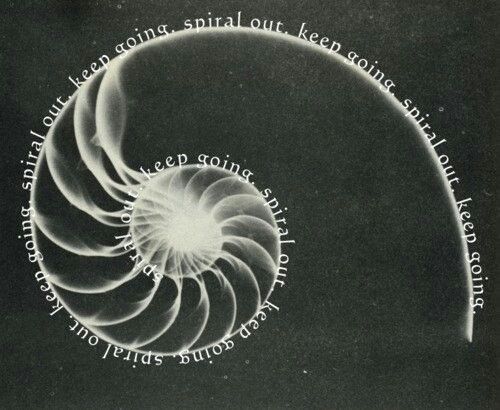
As I was talking to her, I started to explain it like a spiral. In life we are walking, always forward, but in outward spirals. We encounter the same points but we are further along each time. Our experience expands perception. The great soup of being is a lap pool, with every stroke I become more and more and more me.
i love nancy!
4/2/2026
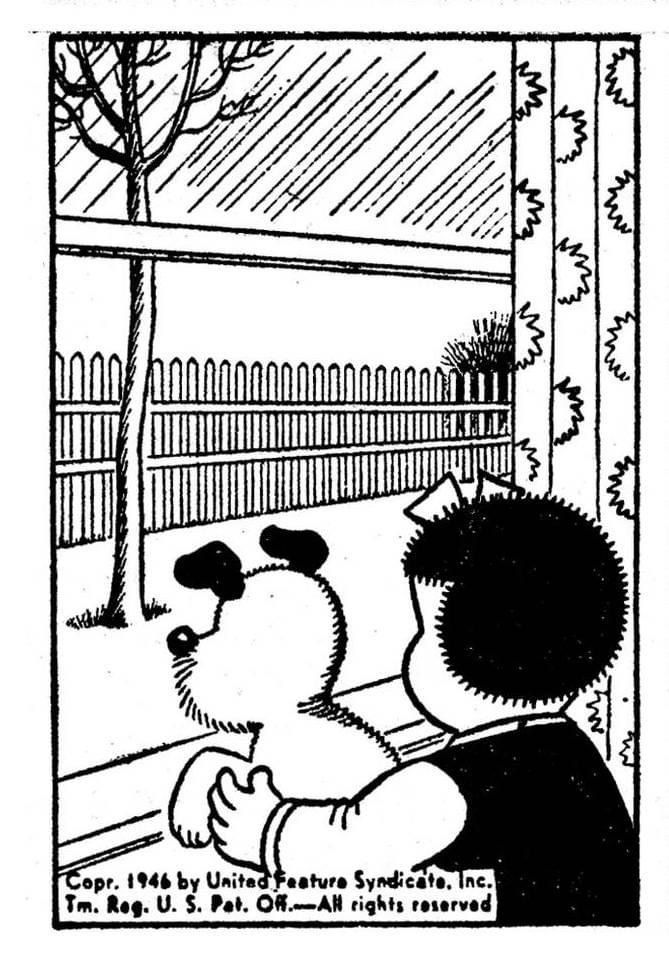
literally me and my dog^
i wish i could remember the first time i stumbled upon the nancy comic. i didn't grow up with her and no one introduced me to her...i think it was probably just pinterest but i wish i could remember the first panel i saw. i loved that girl from the start.
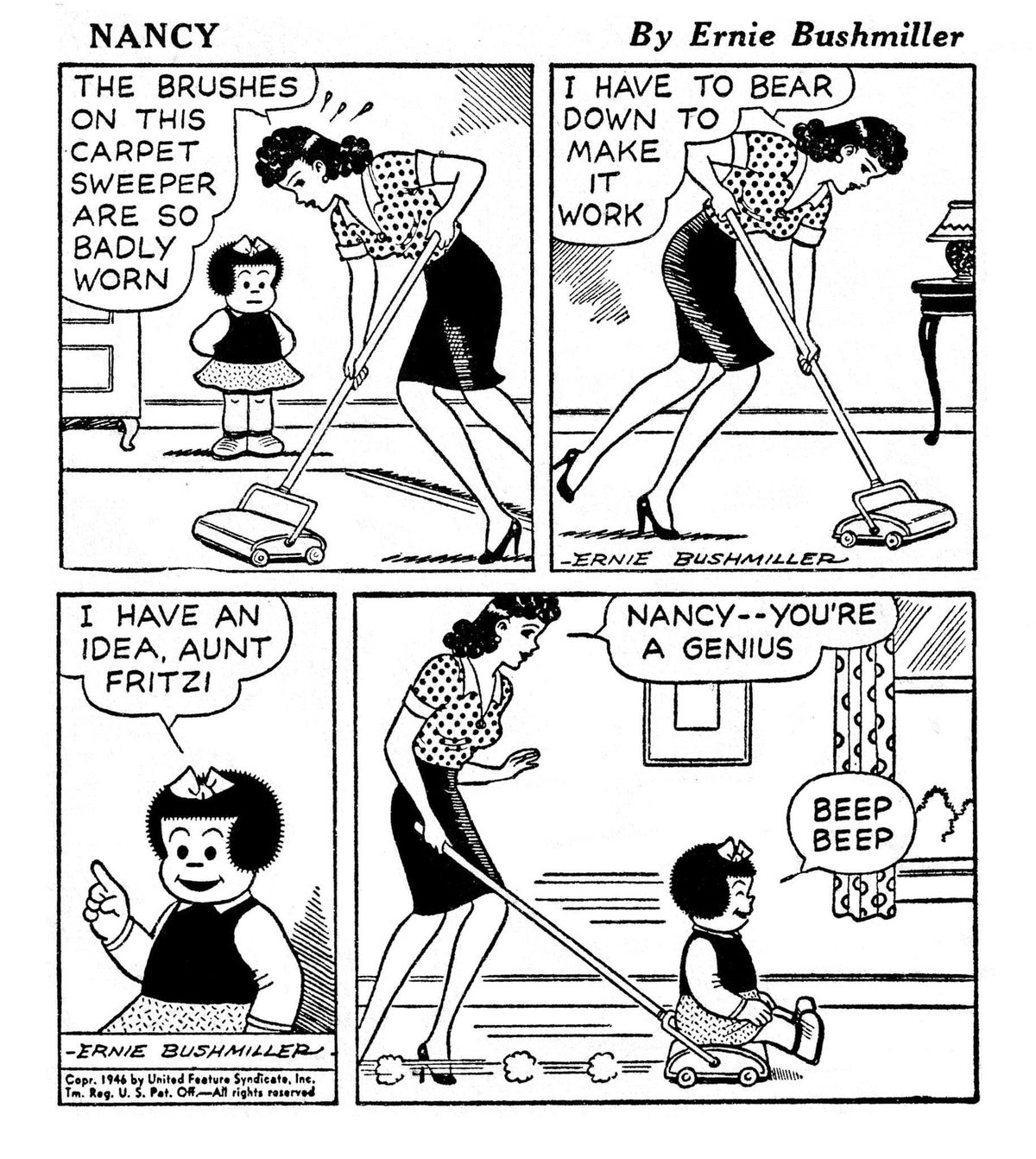
if you don't know who or what im talking about, nancy is the comic strip character on the main page of my site. she's my profile picture for all of my accounts...nancy reading for my goodreads, nancy buying a movie ticket for letterboxd, punk nancy rocking out for my spotify.
i dated a guy that looked like sluggo once (but not an 8 year old) and it was so fun to have a comic strip version of cute moments. now im more like this nancy tho if you know what i mean....
i had never really been interested in comics prior to nancy. theres something so charming about ernie bushmiller's style and the character herself. i honestly really relate to her a lot. she is adorable, stubborn, animal loving, and always clever enough to find a loophole to someone telling her she cant do something. there's also one panel of her crying while looking at a bunch of seagulls that feels so specific to me that i cant believe exists. ive never been able to find the whole strip, so i dont know why she's crying over them, but i love it because i am frequently very moved by birds! there's really a nancy for everything.
she started as a side character introduced in the 1930s strip "fritzi ritz" where she featured as fritzi's niece. according to bushmiller, he "planned to keep her for about a week and then dump her…but the little dickens was soon stealing the show and Bushmiller, the ingrate, was taking all the bows." its no surprise to me that the people were charmed by her and that she found a way to take over the strip
i wanted to dig into bushmiller's process of creating nancy, but honestly, i couldnt find much. his approach to the comic is interesting though. he always started with the gag and the last panel, before figuring out a way to get there. if he couldn't think of a gag, he'd flip through a sears roebuck catalog until inspiration struck him in the image of a vacuum.
on october 30 1938, "nancy" debuted as its own strip and she lives on in (limited) print today! her legacy has been carried out by a handful of artists since bushmiller's death in 1982, and the style has changed noticeably. i tend to stay loyal to OG nancy content and im not sure i agree with dragging it out this far. maybe we need to let things go and stay as they are. im glad people (like me) are still exposed to her character, but i would rather have some old print versions in circulation than new ones (that you also cant find)...that girl is so stubborn and elusive but i will get my hands on an original strip or archive collection at some point!
i wonder what aemelia lanyer would think about saltburn
3/30/2026
for one of my classes this semester, i had to watch saltburn for the first time. i did not like it! but thats not important right now. our class discussion was interesting though...we were talking about how the desire in the film and if its actually sexual/romantic or just about class and status. my professor kept asking if oliver actually had feelings for felix or if all the longing and eroticism was either manipulative or a desire to BE felix. im of the belief that the two cant really be separated. any desire that is that intense becomes erotic at a certain point. further, the desire to be like the one we desire is a pretty common notion. granted, saltburn takes this to an extreme that makes it hard to justify as the sole cause, but i digress.
we were talking about the bathtub scene and the desire to be close to someone through consuming parts of them (cannibalism to the extreme), or being near things they have touched intimately in some capacity. i started thinking of the moving waterlilies (call me by your name arose as the more well known example but it somehow wasnt the first thing that came to mind. in waterlilies, a french film by celine sciamma, a young girl ends up in the bedroom of the girl in her class that she desires; ultimately, she digs through her desk drawers and trash, and finds a discarded apple core that she chews on. this trope is becoming more and more frequent, but i wanted to turn to a 17th century connection i made to this trope of third party object fixation as a means to reach the person we desire, and the blurring of romantic/erotic/class desire.
aemelia lanyer (spelling varies by source) was an english poet, best known for her 1611 piece "salve deux rex judaeorum" which focuses on the passion of christ and includes a feminist defense of women, "eve's apology". her father was the musician of the court of elizabeth i, so she was close to the court circle, and eventually become the mistress of lord hundson. when she became pregnant, she was married to a musician of the court to protect lord hundson's reputation. her connection to the court, led her to tutor and companion margaret clifford, countess of cumberland, and her daughter, anne.
"the description of cookeham" is noted as the first country-house poem, and is lanyer's ode to her time at the estate of the countess (and the countess herself). lanyer describes the beauty of the property and its service to the countess in a way that makes one suspect she is not just talking about the property itself. towards the end of the piece, lanyer is describing the deep sadness of leaving the estate because the countess is leaving/selling the property. she is only tied to this property because of the countess having hired her. as they leave, the countess kisses a tree as a mark of her love of the property. what follows is lanyer's dramatic retelling of her jealousy towards the tree for having received such a kiss from the countess, and how she attempted to take it back by kissing the tree herself. in this piece, like saltburn, lanyer's adoration and yearning for the countess that seems homoerotic is complicated by the conflation of the person with the place and the status it symbolizes.
the power swap of saltburn is also mirrored in this piece. lanyer, like oliver's victorious dance through the halls in the final scene, ends her piece by exclaiming that despite the "rich chains" that tie her to the countess, she is the one with the power as her writing will outlive her and continue to tell the story of their connection.
i had to tell my 17th century lit professor from a few semesters ago about this and she thought it was brilliant. yay me. i also sent her a fanfic i found based on a piece we read in class #fire